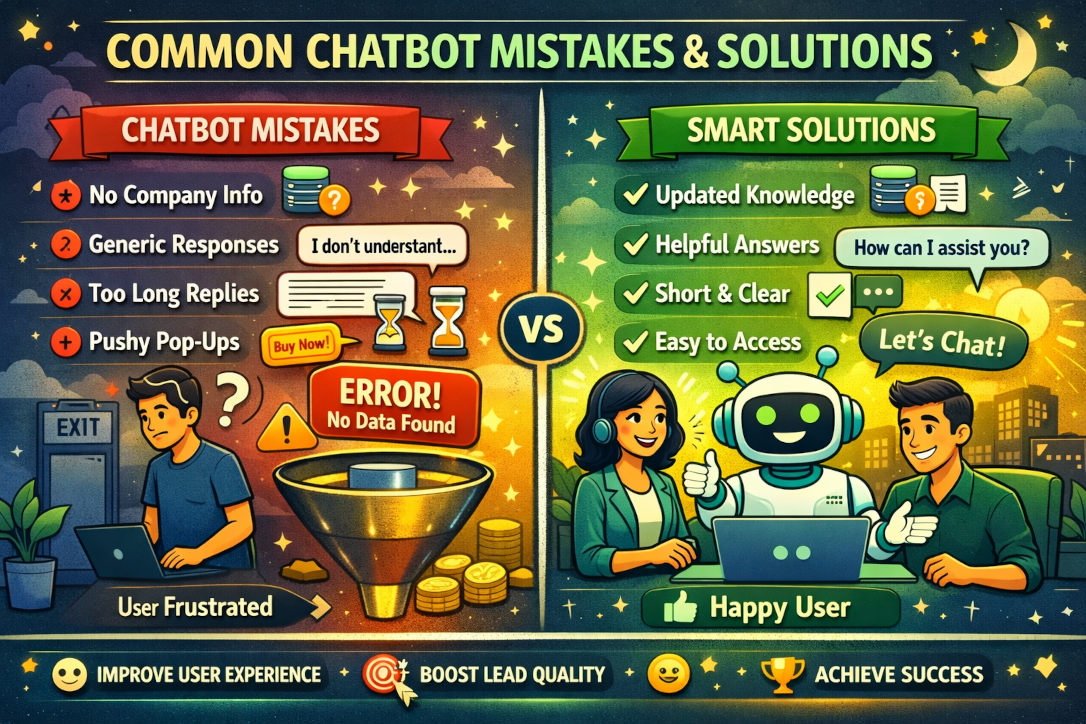
Common Chatbot Mistakes - and How to Avoid Them
Why Many Chatbots Deter Visitors Rather Than Assist Them
More and more companies are relying on chatbots to enhance their customer service and respond to inquiries faster.
However, not every chatbot automatically improves the user experience.
Many visitors know this situation:
Hello! How can I assist you?
After the first question, however:
I cannot answer this question, unfortunately.
The result is frustration—and often, the visitor leaves the website.
The good news: Most chatbot problems can be avoided.
Error 1: The chatbot does not recognize your company
The most common error is at the same time the most serious.
Many chatbots have little to no industry knowledge.
They do not know:
- your performances
- your prices
- your processes
- your products
This results in them providing inaccurate or unusable answers.
So you avoid this mistake.
Maintain a structured knowledge database with all important information about your company.
The better the data base, the more helpful the answers.
Error 2: Too many automated responses
A chatbot should support—not fully automate every situation.
Complex or individual issues often still require a personal point of contact.
A good chatbot recognizes these situations and refers the visitor to a staff member.
Error 3: The chatbot answers questions that no one is asking.
Many companies invest a lot of time in rare special cases.
Common questions remain unanswered.
Instead, start with the questions that are asked almost daily.
For instance:
- What is your service cost?
- How does a project proceed?
- How long will implementation take?
- What services do you offer?
- How can I get in touch?
Error 4: Lack of Personality
A chatbot does not need to appear human.
He should, however, communicate kindly, clearly, and professionally.
Generic standard texts quickly come across as distant.
Better:
Thank you very much for your question. I am happy to assist you further.
A natural language builds trust.
Error 5: Too long responses
Visitors want quick information.
A chatbot should therefore:
- answer precisely
- formulate clearly
- Avoid unnecessary details.
Further information can be provided upon request.
Error 6: Lack of regular maintenance
Companies are constantly changing.
New services, new prices, or new products should also be updated in the chatbot.
Outdated information quickly leads to misunderstandings.
Error 7: No recognition of missing information
A smart chatbot should not simply guess.
Much more helpful is it when the system recognizes:
- frequently asked questions
- which answers are missing
- which contents should be supplemented
The chatbot continually improves.
Error 8: The chatbot is too intrusive.
Many websites open the chat immediately after page load.
This may rather disturb than assist visitors.
It is better to offer the chat in a highly visible manner and let the visitor decide when they need assistance.
Error 9: No clear next step
A chatbot answers questions—but what happens next?
Many conversations conclude without any concrete action.
Instead, the chatbot should meaningfully guide visitors forward.
For instance:
- Contact establishment
- Schedule an appointment
- Request an offer
- view more information
Every conversation should have a clear objective.
Error 10: Trying to solve everything with a single chatbot
A support chatbot has different tasks than a sales chatbot.
Therefore, it may be sensible to define different roles.
For instance:
- Support
- Vertrieb
- Product Consultation
- Onboarding
This makes answers much more targeted.
Checklist for a Successful AI Chatbot
- Current Knowledge Database
- Friendly and understandable answers
- Regular updates
- ✅ Clear role of the chatbot
- ✅ Recognition of missing information
- Contact option
- Short and precise answers
- Regular tests with real questions
How NeoMatX Avoids These Errors
NeoMatX was developed to solve precisely these typical problems of modern chatbots.
The chatbot operates on your own knowledge database, providing company-specific answers instead of general standard texts.
Additionally, NeoMatX automatically identifies when information is missing or visitors ask questions that cannot yet be answered.
Further advantages:
- Several chatbots with different roles
- Multilingual Communication
- Live Preview for Testing
- Simple integration via iFrame
- Customizable design
Frequently Asked Questions (FAQ)
Why do many chatbots perform so poorly?
Often, a well-maintained knowledge database is missing, or the chatbot was not further optimized after its setup.
Can an AI chatbot provide incorrect answers?
Yes. That's why a high-quality knowledge base and regular maintenance are crucial.
How often should a chatbot be updated?
Whenever services, products, prices, or company information change.
Should a chatbot replace human employees?
No. A chatbot is ideal for recurring questions. Complex issues should continue to be handled personally.
Conclusion
A chatbot is only as good as the information its responses are based on.
Avoiding typical errors such as a lack of industry knowledge, outdated content, or unclear communication significantly improves the user experience.
With NeoMatX, you get an AI chatbot based on your knowledge database, which identifies missing information and reliably assists visitors.
A good chatbot does not simply answer questions—it helps visitors make the right decisions faster.